
For decades, annual planning served as the backbone of strategic leadership. Organizations mapped out 12-month roadmaps, set fixed KPIs, and expected teams to execute against the plan with precision. But in 2026, this model feels almost archaic—misaligned with the speed of change, the volatility of global markets, and the increasing interdependence between digital systems, human behaviors, and shifting societal expectations.
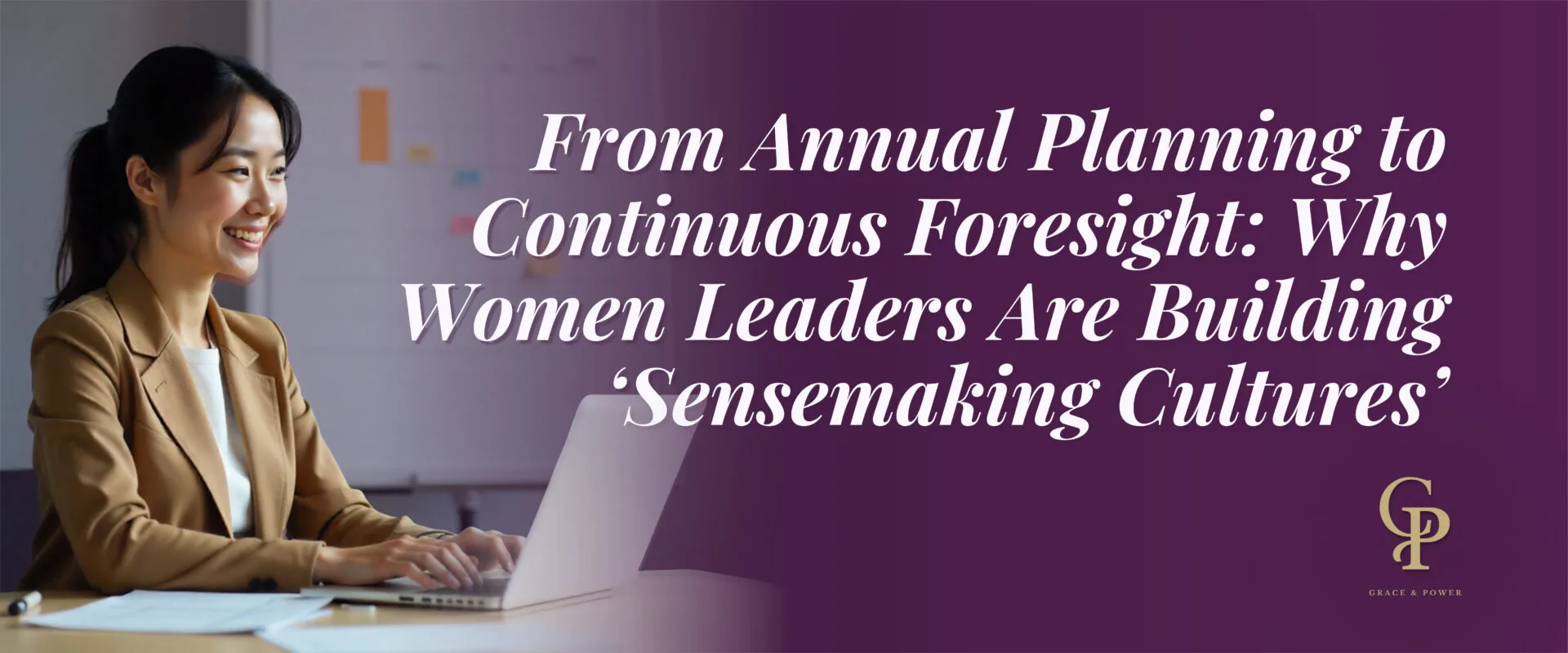
Today’s most forward-thinking women leaders across Southeast Asia are rewriting this script. They are pioneering a shift from annual planning to continuous foresight, building teams and cultures capable not only of adapting to change, but of anticipating it. This approach—rooted in the practice of sensemaking—is becoming the new hallmark of modern leadership.
Sensemaking isn’t merely trend analysis or horizon scanning. It is a deeper discipline: the ability to interpret complexity, connect seemingly unrelated signals, and transform ambiguity into strategic clarity. Women leaders, with their multidimensional leadership lens, human-centered orientation, and high-context decision-making style, are emerging as powerful architects of this new organizational capability.
Why Annual Planning Is No Longer Enough
Annual planning assumes a relatively stable environment. It expects leaders to define a clear path and stick to it with minor adjustments. But today’s landscape is anything but stable:
- AI is reshaping workflows and customer expectations at unprecedented speed.
- Hybrid work is redefining culture, performance, and leadership norms.
- Employee wellbeing, psychological safety, and emotional energy have become critical business imperatives.
- Global macro shifts—from supply chains to geopolitics—require rapid response rather than static plans.
In this context, a rigid 12-month plan can create blind spots, slow down response times, and lock organizations into outdated assumptions. Leaders need ongoing intelligence—not delayed reporting—and they need teams ready to pivot with confidence, not fear.
This is where continuous foresight enters.
Continuous Foresight: The New Leadership Operating System
Continuous foresight is the practice of constantly sensing, interpreting, and responding to emerging shifts—internally, externally, and culturally.
Instead of waiting for quarterly reviews, leaders build processes and cultures that allow them to:
- spot early signals of opportunity or risk
- test assumptions continuously
- experiment with strategies in real time
- pivot without disrupting psychological safety or team performance
- embed learning loops into daily operations
It is a living, breathing strategy framework—much more dynamic, human-centered, and adaptive than traditional planning cycles.
Why Women Leaders Are Uniquely Positioned to Lead This Shift
Across Southeast Asia, women in senior roles are shaping transformation by leveraging strengths aligned with sensemaking:
1. Multidimensional Thinking
Women leaders often consider decisions through multiple lenses—human, operational, cultural, and strategic. This holistic approach is essential in environments where decisions have ripple effects across the organization.
2. High Social Intelligence
Sensemaking is not just data interpretation. It’s reading emotions, energy, behavior, and culture. Women leaders excel at extracting meaning from social signals, which strengthens their ability to anticipate shifts in organizational dynamics.
3. Strong Adaptive Capacity
Women leaders have long operated in environments requiring constant adaptation. This lived experience naturally feeds into continuous foresight—flexibility isn’t a skill; it’s a survival muscle.
4. Ability to Create Psychological Safety
Without psychological safety, continuous foresight collapses. Teams cannot share insights, challenge assumptions, or surface early warnings. Women leaders are often the catalysts for cultures where people feel safe speaking up.
5. Human-Centered Leadership
In a world where strategy and culture are inseparable, women leaders drive both with empathy and clarity—ensuring foresight is not just analytical but deeply grounded in lived reality.
What ‘Sensemaking Cultures’ Actually Look Like
In organizations building sensemaking cultures, three qualities stand out:
1. Curiosity Over Certainty
Instead of asking, “What’s our plan?” teams ask:
“What are we noticing that others aren’t yet seeing?”
“What assumptions might be outdated?”
“What is emerging that could reshape our priorities?”
Curiosity fuels foresight.
2. Real-Time Learning Loops
Teams routinely reflect on what’s working, what’s shifting, and what requires recalibration. This transforms reflection into a strategic asset.
3. Cross-Functional Intelligence Sharing
Sensemaking cultures empower leaders from people, tech, strategy, and operations to bring signals from their domains. Patterns emerge, clarity sharpens, and decisions accelerate.
These organizations become more resilient because they are constantly dialoguing with reality—not outdated projections.
From Reactive to Regenerative Leadership
The shift to continuous foresight isn’t simply tactical. It signals a deeper shift in leadership identity. Women leaders are embracing a regenerative leadership model—one focused on renewal, adaptability, and sustained clarity.
Instead of asking, “How do we control the future?” they ask,
“How do we stay in relationship with the future?”
This mindset invites flexibility, enables innovation, and reduces burnout by removing the pressure to “get the plan right” and instead focusing on responding to what is unfolding.
The Future Belongs to Organizations That Can Sense, Not Just Plan
The next era of leadership belongs to those who can interpret complexity, not avoid it. Women leaders in APAC are proving that the most powerful strategic advantage is not speed, nor scale, but sensemaking—the ability to transform constant flux into direction and clarity.
As organizations move from annual planning to continuous foresight, they are discovering that strategy is no longer a document.
It is a living conversation.
And women leaders are leading that conversation with depth, intelligence, and humanity.